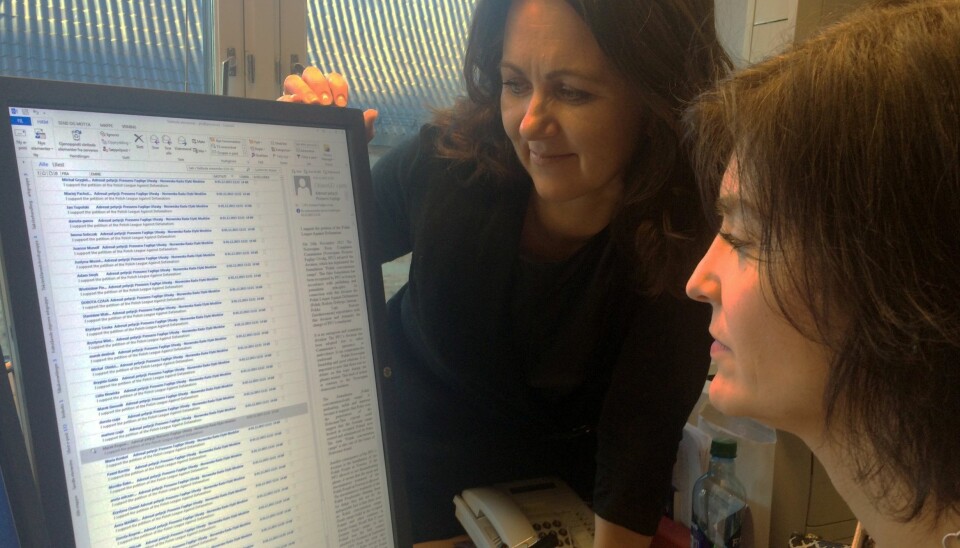
Deputy Secretary General Reidun Kjelling Nybø (left) from the Association of Norwegian Editors and Secretary General Kjersti Løken Stavrum from the Norwegian Press Association has deleted thousands of emails from angry Poles. Foto: Ingrid Nergården Jortveit/NPA
Decision from Norwegian Press Complaints Commission raises fury among Poles
Mailboxes of press associations in Norway are filled with thousands of emails from angry Poles reacting to a newspaper article stating that Auschwitz was a “Polish concentration camp”.
August 15 the Norwegian local newspaper Avisa Sør-Trøndelag published a review of the 2008 movie “The Reader” with Kate Winslet in the leading role. The review stated that her character “Hanna Schmitz is in court impeached for war crimes against a large number of jews in a Polish concentration camp.”
Polacy: Co jest podłożem polsko-norweskiego sporu o Auschwitz
Offensive
To describe Auschwitz as a “Polish concentration camp” made the Norwegian-Polish editor and journalist Henryk E. Malinowski file a complaint to the Norwegian Press Complaints Commission (in Norwegian: PFU). In the complaint he characterized the term as offensive against Poland and Poles.
On November 24 the PFU decided that Avisa Sør-Trøndelag had not violated the Code of Ethics for Norwegian media. The commission builds the decision on an apology from the newspaper and that it believes the newspaper´s explanation that the term was used to express that Auschwitz geographically was placed in Poland.
Flooded mailboxes
A few days after the decision the mailboxes of Norwegian Press Association (NP) and Norwegian Association of Editors (NR) started flooding with mails from angry Poles. Secretary General Kjersti Løken Stavrum in NP, who administers the press complaints process, says she takes note of the case as an example of journalism crossing borders.
– I have deleted over 10.000 emails. While we speak I receive several every second. We are defenseless towards these kinds of actions. It all started Sunday, and has increased since, Løken Stavrum stated to Journalisten.no on Monday.
On Wednesday she told Journalisten.no that the press assocations has received over 24.000 emails.
– It is a misunderstanding that the PFU recognised the error made by Avisa Sør-Trøndelag, Løken Stavrum added.
In the newspaper itself almost no emails has been received (article in Norwegian). The editor underlines that the newspaper made an apology on Facebook August 17 for using the term “polish concentration camp”, and then again in the printed edition August 18.
The wave of protests seem to have been bolstered by a campaign run by the Polish League Against Defamation through the website citizengo.org. Several of the emails have the same message:
“It is an outrageous and scandalous decision. The PFU’s decision has been adopted due to either Commission’s ignorance or malevolence. It can compromise the traditional Polish-Norwegian friendship and good relations”.
The campaign threatens to boycott Norwegian products unless the NPCC reevaluate their decision.
Thursday the NP published both an English and a Polish translation of the full statement from the Norwegian Press Complaints Commission. Read the complete statement below.
War history and press ethics
Alf Bjarne Johnsen who leads the complaints commission as a representative for Norwegian journalists states that he doesn’t understand the rationale behind the campaign.
– PFU evaluates press ethics, not war history. The PFU stands firm on this matter, Johnsen, who works as a journalist in the leading tabloid newspaper VG in Norway, tells Journalisten.no.
He underlines that the PFU concluded on basis that the apology from Avisa Sør-Trøndelag counterbalanced the breach of the code of ethics.
But not all Norwegians support the PFU decision. Former PFU member and editor of the tabloid newspaper Dagbladet John Olav Egeland disagrees with Johnsen.
– Of course war history is a matter for the code of press ethics. There are limits to the errors the NPCC should wave off under the argument that an apology has been made. Would the Commission think it is an acceptable error to characterize Vidkun Quisling as leader of the Norwegian resistance movement, he asks on this public Facebook profile.
The full statement from the Norwegian Press Complaints Commission “The submitted complaint is in regard to a film review presented in Avisa Sør-Trøndelag, where the term “Polish concentration camp” was used to describe the contents of the film entitled “The Reader”. The complainant represents ScanPress.net, a Norwegian-based and Polish language website. He objects to the terminology, which he believes links Poland and the Polish people to German war crimes. From the complainant’s standpoint, Avisa Sør-Trøndelag has spread false information and presented a distorted version of historical facts, while at the same time insulting Poland and the Polish people through its use of terminology. The complainant argues that since the media contributes toward the establishment of common knowledge, it is crucial that they adhere to the facts. If this type of misinformation is repeated often enough, it will eventually be perceived as the truth. This, the complainant states, will cause substantial harm that may be difficult to repair. Avisa Sør-Trøndelag apologises for the use of this terminology and grants that it was imprecise. However, the editorial staff submits that the term was used solely because the camp was located in Poland, and that this in no way places responsibility for what occurred in the concentration camps on the Polish people. The journalists were not aware that their use of terminology could be considered hurtful to the Polish people, although the editor conceded that the terminology would have been altered had he been able to read the review prior to its publication. Nonetheless, Avisa Sør-Trøndelag cannot see that this error is so serious as to constitute a violation of the ethics of responsible journalism. The editorial staff has informed the commission that they have published an apology, though they believe it is highly unlikely that the film review could have led the public to believe that the atrocities in the camps were carried out by anyone but the Germans. The Norwegian Press Complaints Commission concludes that the issue at hand involves the way in which the term “Polish concentration camp” is interpreted and understood. Although World War II took place a long time ago, the fact the Germans constructed and operated concentration camps during the war has become well-established common knowledge. That does not mean that this common knowledge will remain firmly fixed in perpetuity. The commission therefore believes that the complaint, as presented by the complainant, is important to ensure that the public is made aware of the use of this terminology and the issue associated with it. The commission also notes that this terminology has sparked international controversy, and understands that the Polish people view it as offensive, given the exceptionally grave historical events associated with the terminology. It is essential to show the utmost respect for historical facts. As stated in the conclusion of the Ethical Code of Practice for the Norwegian Press, words and images are powerful weapons which must never be abused. The media must therefore remain conscious of its choice of words, and strive toward accuracy and a correct representation of the facts. The commission accepts Avisa Sør-Trøndelag’s explanation that it was never their intention to distort historical facts or link the Polish people to Nazi atrocities. Their intent was instead to convey that the camp was located in Poland. The commission agrees with the complainant’s argument that a reader might interpret “Polish concentration camp” as a camp established by Polish authorities, and in this sense, the editorial staff would have presented erroneous information. In accordance with Section 4.13 of the Ethical Code of Practice for the Norwegian Press, erroneous information must be corrected and apologies must be made. The commission confirms that Avisa Sør-Trøndelag has presented an apology and also acknowledged that their use of terminology was imprecise. The commission agrees that the editorial staff should have used a more precise formulation. Avisa Sør-Trøndelag has not violated the ethics of responsible journalism.” |
Journalisten.no is a Norwegian trade news website for the media industry. Journalisten.no is owned by the Norwegian Union of Journalists. Journalisten.no is edited in accordance with the Code of Ethics of the Norwegian Press and Rights and Duties of the Editor.